Thursday, 13 June 2024

Digital Humans: How Hollywood Is Readying for Replicants

NAB

Photoreal full-body synthetic humans, whether fictional or the digital twin of a real person, are coming to a screen near you.

article here

The next evolution of the digital human is going to have a more in-depth relationship with us because, not only will it be photoreal, it will be able to connect with us emotionally, said a panel of industry experts at the 2024 NAB Show in a session entitled “The Case for Digital Humans.”

Soul Machines aims to build digital humans which deliver a more “empathetic, humanistic experience” with AI, said Fay Wells, the company’s head of partner marketing.

“We really think about them as that next layer of human interactivity,” Wells explained. “We humanize AI through embodied agents with biological AI. What we believe is that this is really a path to superhuman intelligence, and more human like experiences with AI that sit at the intersection of both physical and digital worlds.

Soul Machines, she said, has created a tool that “democratizes” the creation of digital humans. “With Soul Machine Studio, you can create, customize, train and deploy digital humans.”

She further explained that its technology is built on cognitive modeling.

“What happens in the human brain corresponds with the human face so when you interact with these avatars, they can see [your facial responses], process that and react accordingly.”

It claims to be able to create digital people that can “see, hear, interact, empathize and even create memories the same way as real humans.”

Soul Machines CEO and co-founder Mark Sagar is the director of the Laboratory for Animate Technologies at the Auckland Bioengineering Institute and a two-time Academy Award winner for Avatar and King Kong. Sager has pioneered more humanlike ways in which we relate to technology and AI by combining biologically based models of faces and neural systems to create live interactive systems.

“Effectively the technology works through physical camera and audio interface,” Wells said. “For example, if you were having a conversation with a digital human, and you smiled, they would recognize that and they would smile, if you frowned or looked upset, they would risk that they would recognize that and do that.”

The tech is already in demand, she said, and use cases are growing including by celebrities seeking an opportunity to make money by being in more than one place at once.

“Typically, celebs are looking for ways to extend their brand’s interaction with their fans but they want to do this with money attached to it, right. With digital humans we unlock a lot of revenue opportunities. You can use something like a subscription model to have access to one of these celebs to talk about different things [in promotional contexts].

“You can have a digital human as a brand ambassador or a customer service person. They can do that 24/7 so you’re not just confined to that nine to five space.”

Wells claimed that customer satisfaction levels and therefore brand loyalty increases with the use of more empathetic digital humans.

While the digital humans of Soul Machines start life as synthetic and learn to empathize, the lifelike avatars of Wild Capture are drawn from the more traditional process of performance capture.

Wild Capture claims its AI-infused pipeline, however, has sped up the typically time- and resource-consuming process.

Co-founder and CEO Will Driscoll explained that Wild Capture utilizes a streamlined volumetric video solution to deliver “interoperable, lifelike digital human assets of individual talent” for use in crowd scenes with “unparalleled realism” across sectors like fashion, sports, automotive and training.

“As the spatial media landscape evolves rapidly, we’re actively exploring avenues for talent to monetize their scanned captures beyond traditional production,” Driscoll said.

His company recently worked on Francis Ford Coppola’s movie Megalopolis, delivering 200 digital assets including characters integrated throughout the film.

“We’re in the live performance to capture asset process,” he said. “We’re dealing with the authentic performance derived directly from the original performance of the person.

“We’ve automated the process and made the modification process easy for all walks of production. We’re able to build story arcs to make them interactive, but they’re not going to answer questions on the fly.”

Driscoll said this was the key difference between Wild Capture and Soul Machines. “However, if you need an unadulterated message from a politician, a pop star or an athlete, seeing their true nuances of their authentic performance, we’re able to bring it in real time to the web.”

He emphasized the company’s engagement with digital rights management and copy right as well as with individual talent whether living or deceased.

"By getting the talent to embrace it, rather than fearing it, you get more quality content produced,” Driscoll said. “We’ve worked with talent to help them monetize their own likeness. We catalog all the metadata, bringing that through the entire process.

“Managing that data ethically, on behalf of the creative community is incredibly important, because those are our users and creators.”

He said there was likely to be increased demand for digital humans as film and gaming merge.

“We’re on that precipice where cinema and games come together to create an interactive story. We’ve automated and simplified the process of constructing characters from the footage.”


European subscription market still lucrative opportunity despite affordability concerns

Stream TV Insider

Price hikes, password-sharing crackdowns, and a cost of living crisis are deterring European subscribers from spending more on subscription services – but not by as much as one might think.

article here here 

Appetite for subscriptions remains high, with 60% of British consumers saying they’d sign up to more subscriptions if they could afford it, according to a new report from UK payment processing company Bango.

Even a tax on streaming services introduced in several European countries doesn’t seem to have deterred consumers from subscribing, according to Bango. Its report is drawn from a survey of 5,000 subscribers across UK, France, Spain, Germany, and Italy.  

Although they spend less than counterparts in the U.S. - €696 ($754) compared to €863 ($935) - one in five European consumers are likely to add another subscription to their list soon in order to watch the Paris Olympics.

The average European subscriber has 3.2 subscriptions, while the average American subscriber has 4.5. Note that in Bango’s report ‘subscriptions’ includes SVOD alongside subs to other services, from retail and gaming to food boxes.

Despite high cost of living concerns, UK subscribers are now spending €68 ($74) per month on subscription apps and services every year — on top of standard bills such as TV, phone, and internet. One in eight are paying more than €117 ($127) a month for their subscriptions, amounting to €1400 ($1,510) per year. That’s the highest in Europe, per the report.

British consumers are also the most likely to have a subscription which they always keep and never pause or cancel. Almost two-thirds (60%) can’t afford all the subscriptions they want. Nearly half (45%) have canceled due to recent price hikes, with 28% discouraged by the introduction of ads.

Paul Larbey, CEO of Bango said, “The UK consumer’s appetite for subscriptions now adds up to a material chunk of monthly household spending. While there is a clear appetite for subscriptions, affordability is a key concern.”

Across Europe, about 60% of consumers also say they can’t afford all the subscriptions they would like. Yet over a quarter (28%) said they don’t actually know how much they spend monthly on subscriptions.

After services like Amazon Prime Video, Disney+ and Netflix introduced cheaper advertising tiers nearly a third (31%) of subscribers have downgraded while 28% have canceled altogether.

Nonetheless, about a quarter of Europeans have actually upgraded their subscription and 76%believe paid subscriptions should never display ads.

Tax on streaming

In 2020, France implemented a tax on streaming services, often referred to as the ‘Netflix tax’ or ‘streaming tax’. This levy requires streaming platforms to contribute a percentage of their revenue - potentially as high as 5.15% - generated in France to the French National Cinema Center (CNC). Funds collected are used to support French film and television productions, ensuring the continued growth and promotion of local content.

Germany, Belgium and Italy have passed similar legislation.

“It’s a lengthening list of regulations designed to protect regional media and promote service transparency in the face of the US streaming monopoly,” said Larbey. “While it’s been reported as a controversial move in France, it hasn’t undermined the growth of the subscription market in the region.”

Of respondents to Bango’s survey 31% said they would object to the introduction of a France-style tax on streaming services in their country.

And 94% of French subscribers have continued to pay for their music subscription services since the introduction of the 2024 music-streaming tax, which saw Spotify raise its prices locally.

Market subscription breakdowns

France

Subscribers in France pay an average €65 ($70) for subscriptions per month. This is despite French subscribers having the least number of subscriptions (3) compared to four other countries in the survey.

Crackdowns on password sharing have seen a third (33%) of subscribers now pay for a service they used to access for free. French subscribers are apparently open to paying more for a service that fits their needs, per this survey.

In fact, notes Bango, “they’d be willing to pay the most of all European countries for an all-in-one content hub.”

Spain

The average subscriber pays €60 ($65) per month. For service providers, the introduction of advertising would appear to be the least popular tactic when it comes to improving affordability, with almost a third (31%) of subscribers canceling as a result. Of respondents in Spain, 81% said paid subscriptions should never include ads – more than any other nation in our survey. 

Germany

With an average monthly spend lower than that of its European neighbors, subscribers in Germany appear the least likely to cancel following price hikes and the introduction of ads. That said, over half (53%) say they can’t afford all the subscriptions they want, per the survey. German subscribers are also the most likely to lose track of how much they spend on subscriptions, with roughly 1 in 4  paying for a subscription they’re not currently using. 

Italy

Italians pay the least on average per month for their subscriptions at €50 ($54). They are the most likely to cancel a subscription following a price increase and the most likely to downgrade to an ad-supported tier. Nearly 60% said they can’t afford all the subscriptions they want, yet almost a third (30%) pay for a subscription they aren’t currently using. Despite price sensitivity, Italian subscribers wouldn’t object to a France-style streaming tax being introduced.

More work needed to reduce subscription friction

“Even in the face of increasing regulatory hurdles, the European subscription market remains a lucrative opportunity for subscription services,” said Larbey. 

But more can be done to reduce friction, not least because most European subscribers (65%) feel there are too many subscription services to deal with.  Just under half (46%) are “annoyed” they can’t manage all of their subscriptions in one place.

“Fed up with the complexity of managing so many subscriptions, many subscribers just stick to one or two key services,” commented Larbey. “Others have abandoned the market altogether and turned to online piracy instead.”

To back that up Bango highlighted a 2022 study by the EU’s Intellectual Property Office revealing that the number of users across the continent accessing illegal content  declined between 2017 and 2021 then reversed when digital piracy increased by 3.3% in 2022. The report blamed disjointed services and a lack of legal, all-in one options for content.

Bango is using the report to argue for telcos and other service providers to aggregate more subscription services under their roof. That serves Bango’s interest because it provides a platform for telcos to bundle subscriber payments, including help power Verizon’s +play aggregation hub in the U.S.

To be fair, there does seem widespread consumer appetite for change.

Half of Europeans in the survey said they want the ability to pay multiple subscriptions via one monthly bill. Over half (58%) want one app to manage all of their subscriptions and accounts. In Spain, it’s as high as 67%.

“European subscribers have made it clear that, just like in the US and Australia, they want telcos to offer these all-in-one content hubs,” Larbey said. “And they’re willing to pay for it. European telcos are already creating subscription-based deals but few combine subscriptions outside SVOD. Mobile and broadband providers are primed to take the next step into offering all-in-one content and subscription management platforms, moving from bundling to what we call ‘Super Bundling’.”


How Do You Deliver Sports Personalization at an Olympic Scale? Yiannis Exarchos Is Warming Up for Paris.

NAB

Next month, the host broadcaster for the Paris 2024 Olympics plans to produce 11,000 hours of content, compressing the equivalent of 450 days of content into just 17 days. This includes not only live competition coverage but also behind-the-scenes content, digital offerings, and even augmented reality experiences.

article here

“I don’t think that there is a network in the world that produces that in a year,” says Yiannis Exarchos, CEO of Olympic Broadcasting Services (OBS).

In conversation with fellow sports production executive and A Guy with a Scarf podcast host Carlo De Marchis, Exarchos explains that the content that OBS has to cover is vastly more complex than that for a soccer World Cup or Super Bowl. (You can listen to the full discussion below.)

“The Olympic Games is still one of the few events that have this unique capacity to aggregate very large and diverse audiences,” he says, pointing out that long-form coverage remains as important as clips published on social media.

“I would say that coverage is probably equal measures geared towards linear television and digital. At the heart of what we do, long-form storytelling remains very, very important.”

“Something else that I think is changing is how much broadcasters are interested in getting closer and closer access to the athletes. This will be noticeable in our coverage in Paris.

“Our coverage will go behind the scenes and close to the athletes from the moment when they arrive in a venue. It’s very, very clear that [viewers] care a lot about that.”

Exarchos has been involved with the Olympics since 1997, when he assisted the Athens bidding committee. He helped set up the host broadcasting operation for the Athens 2004 Games and subsequently the IOC’s own host operation OBS, which it took in-house to better manage the sheer scale and complexity of the job.


OBS’s approach, which has evolved over successive Games, is to allow rights-holding broadcasters to customize their coverage by selecting different content modules.

“We’re doing our coverage in a modular way that allows broadcasters to use different parts and create a product that’s more customized for their own audiences,” he says.

One example is that every Olympic sport is produced with a linear international feed and a parallel feed called “multi-clips.”

“This feed is made up of different clips that we [curate] to give broadcasters the option to pick up cameras that maybe we don’t use, or longer length of some shots, or shots which are fantastic, but for some reason we have not used it in the international feed,” Exarchos explains.

“Because of the nature of the broadcast format we cannot follow all athletes from beginning to the end, but we can give that opportunity to broadcasters if they want.”

The host operation can use the multi-sport nature of the Games to trial tech advancements in one sport before expanding them wider.

On the one hand, OBS uses new technology where it helps with storytelling, and, on the other, to create efficiency savings in cost or reduction of CO2.

“What we’re trying to do is to create space for new things by creating very radical efficiencies,” Exarchos says. “This has been helped by adoption of technologies which may not be directly visible to the end user, but which have ended up allowing us things that the end user can see.”

The gradual adoption of cloud resources (operated by Chinese group Tencent) is key here. When they started using data centers in Beijing 2018, “some broadcasters were very skeptical” about whether cloud could be used for HD. This year, the source format is 4K UHD and the majority of transmission will be hosted in the cloud.

More visible innovations include 3D replays generated with the help of AI, and more dynamic graphics to help viewers better understand the action.

For the first time OBS will employ AI to generate highlights “very fast, in different formats, whether for traditional television, for social media, vertical feeders, horizontal videos [and] for all sports,” he said.

“The beauty of it is that broadcasters will be able to customize these highlights [how] they want” for example to fit a national profile or for different moods.”

While acknowledging the immense potential of AI, Exarchos emphasizes the need for structured and responsible implementation. He foresees a future where AI tools are trained with more contained and structured datasets to ensure consistency and adherence to ethical standards.

“I’m a believer in the huge capacities of AI. I’m also very aware of the incredible risks that are associated, especially on the ethical front,” he cautions.

The sale of TV rights is essential not just to the future of the Olympic Games every four years but the survival of many Olympic sports, he claims.

Seventy percent of revenues from the Olympics come from media rights, of which the IOC retains less than 10% for its own operation, he adds. The rest is distributed to national Olympic Committees and International Federations.

“The money from the Games’ TV rights fund the continuation of most Olympic sports. I’m not talking about football or basketball — or the few very commercialized and very successful sports — but for the majority of sports, the amounts coming from the games is fundamental for their survival.”

Also important in this regard are the partnerships with Warner Bros. Discovery, NBCU and Netflix, for which OBS has produced Olympic-based docs.

“It’s very important for us because it opens up Olympic storytelling to audiences that many of the streaming platforms reach and demographics that many of the streaming platform reach on a constant basis. Maybe we don’t need that so much but certain Olympic sports need that [attention] in between the Games.”


Wednesday, 12 June 2024

Digital Humans Are Becoming the Face of the Computer… Interface

NAB

article here  

Digital humans are poised to redefine how businesses, ranging from healthcare to entertainment, interact with their customers. 

“This is the incredible reality of digital humans,” says Jensen Huang, who runs $3 trillion company Nvidia (that makes the chips on which AI services run). “Digital humans will revolutionize industries, from customer service, to advertising and gaming. The possibilities for digital humans are endless.”

Nvidia Ace is a new suite of digital human generative AI technologies, handling automatic speech recognition, language understanding and contextual response-generation, realistic facial animation and realistic skin and hair.

Huang points to breakthroughs in multi-modal large language models (LLMs) and neural graphics as bringing us all closer to a future of “intent-driven computing, where interacting with computers is as natural as interacting with humans.”

According to Born Digital CEO Tomáš Malovec, “It’s clear that digital humans are not just the future of customer experience — they are the present.”

Digital humans are not simply glorified chatbots, he says. They use AI for natural language processing, allowing them to understand complex queries and even respond to emotional cues. 

“This level of sophistication enables them to engage in natural, flowing conversations, fostering a sense of connection with the customer,” Malovec says.

Nor do digital humans stop learning after their initial training. “Continuous learning mechanisms are built-in, allowing them to constantly evolve,” Malovec says.

“This eliminates the need for manual updates. In essence, digital humans operate like intelligent virtual sponges, constantly absorbing information and refining their abilities to deliver a more natural and effective user experience.”

Companies in customer service and healthcare have been the first to adopt Nvidia’s digital human technologies but use cases are cropping up in gaming and entertainment. 

“AI brand ambassadors are setting the next marketing and advertising trends,” said Huang.

Video Games

Aww Inc., a virtual human company based in Japan, launched its first virtual celebrity, Imma, in 2018 and has since become the face of major global brands in more than 50 countries.  

Virtual celebrity Imma, developed by Aww Inc.

Among applications in video games include the use of AI to create more interactive non-playable characters. Covert Protocol is a technology demonstration of this, created by Inworld AI that uses Nvidia’s tools to deliver speech-to-text and lifelike facial performances.

“The combination of Nvidia Ace microservices and the Inworld Engine enables developers to create digital characters that can drive dynamic narratives, opening new possibilities for how gamers can decipher, deduce and play,” Inworld AI CEO Kylan Gibb says.

Perfect World Games, a game developer and publisher, is using Nvidia’s tool suite in its soon-to-be-released game, Legends, showcased in a recent demonstration.

Players can interact with a fully interactive, realistic, multilingual, AI non-playing character in either English or Mandarin, all while the character’s audio responses generate realistic facial animation in real time.

Music Industry

An AI-powered digital DJ which fuses 3D technology from the world of gaming with voice cloning and motion capture, was demonstrated in a video promo for UK-based developer Sum Vivas on CNN.

The avatar is named Dex and is apparently building a social media following branching out from music into digital fashion.

“We’re working with record labels and with promoters on shows,” says Denise Harris, cofounder and CCO at Dex creator Sum Vivas. “We’re working with brands now to do influencer-type brand collaborations.”

“Utilizing digital humans integrated with AI helps to bridge the gap between technology [and] people,” said the aptly named Rob Sims, cofounder and CEO at Sum Vivas. “They don’t take holidays. They have the ability to be multilingual. And they learn and remember every conversation.”

“We don’t see this as a business that’s going to take over people’s jobs,” Harris asserts. “We’re going to create jobs to be able to create these digital humans that will help in businesses.”


“Baby Reindeer” Feels Bad, But It Looks Amazing. Here’s How the Creative Team Made Such a Unique Viewing Experience.

NAB

You’d be hard-pressed to find someone who hasn’t at least heard of the Netflix series ‟Baby Reindeer.” It’s one of those watercooler series that everyone will have an opinion of — whether disgusting, moving, discomforting or compelling. It shot to number one globally on Netflix’s charts.

article herehere

It’s the story of struggling comic Donny and Martha, a woman who won’t take no for an answer. She stalks Donny to the extent of sending 41,071 emails, 350 hours of voicemail, 744 tweets, dozens of Facebook messages and letters over several years.

But as viewers will be aware, this is only half of the tale, which is largely based on the real-life experience of Richard Gadd, who wrote and starred in the show.

“It is a stalker story, but it’s a stalker story with a twist. It shows the side of stalking which isn’t necessarily black and white,” Gadd says in a making of video.

The series stems from his own experiences and was first performed as a one man show at the Edinburgh Festival, which he also performed on stage in London.

“And it was at that point that Netflix came to me were like, ‘Have you ever thought about putting this in a series?’ and I was like ‘Yes, I have’. And it was a hell of a journey.”

Everyone wants to talk about episode four, which is where the story really shifts its register into dark, dark places. Donny is depicted in an on-screen a rape, which Gadd says he experienced in real-life. It also includes scenes of grooming, drug abuse and nightmare drug experiences.

“It was a hell of a thing to write and shoot,” Gadd says. “It kind of shows the side of abuse that I don’t think we’ve seen before.

“I still think there’s an idea that sexual abuse is a kind of a pill and a drink that dissolves and someone wakes up and they don’t know where they are. And that does happen. And that is a big problem.”

Gadd says he went through hundreds and hundreds of drafts of each script, finally finding what he wanted in episode four that was the key to the show.

“I fully believe that writing is rewriting,” Gadd told Krista Smith at the ‟Skip Intro” podcast. “You get there through constantly rewriting and questioning. I remember having a moment when I wrote episode four, where I thought I’m sort of capturing the tone of this.

“Now I think I understand what this is. The kind of weird humor mixed with the darkness, the sudden lightness, but then the sudden darkness.”

He says he shed physical weight to play the scene. “I sort of really wanted to capture the brokenness that I felt at the time not like method acting or like I’m in character all the time, but I really wanted to feel what I felt back then. And so I did a lot of psychological, quite painful recall and trying to get my body into place where I felt vulnerable.”

However, ‟Baby Reindeer” doesn’t demonize the stalker, Martha. We feel sympathy for her, in part because we feel the vulnerability of a person who has experienced what Donny goes through in episode 4.

“I really believed in the show, and I thought that it would be liked — but to this scale?” Gadd told Skip Intro. “I never thought in a million years. It’s such a singular idiosyncratic sort of experience, a niche story of a comedian and his odd relationship with his stalker and all the things that have happened in his past. It’s just struck a chord with so many people. It’s kind of overwhelming.”

Donny’s questionable actions in the course of the drama only serve to highlight the humanity of his situation.

Gadd refuses to be drawn any further on the moral debate around the show. He said, “My ultimate hope is that it moves people, that it touches people, and it affects people. It’s born out of true events. It’s born out of a real life happening. Ultimately, it is just an autobiographical story that I felt the need to tell, the story of a messed up period in my life.”


Lensing ‟Baby Reindeer”

The series is directed by Weronika Tofilska and Josephine Bornebusch, and it was shot by Krzysztof Trojnar and Annika Summerson.

Trojnar lensed the first four of the seven 30-minute episodes. Speaking with Ben Consoli of the ‟Go Creative” podcast, Trojnar said his initial creative conversations were about the character being stuck: “That kind of sense of intensity and oppression the sense of the world pressing down on the character, or Martha intruding into his life was how we decided to portray the state of the character.”

Although the series is in London, they chose to deliberately keep the frame claustrophobic, so we can’t really see too much of the city.

“We never show too much sky,” says Trojnar. “There is no sense of comfort or space, apart from one scene when he’s in Edinburgh, and it’s a flashback where everything feels a little bit more optimistic.”

Trojnar puts his Alexa Mini LF camera up close to the characters, invading and crushing their space. He says he fought to include non-obvious shots, such as the coke being poured.

“It was so important that we see it from the top, we see it from Donny’s perspective, as you would looking down in the counter, you would see it as a top shot.

“This is really important that it gets established that way and it’s its first one of the first shots of the film so we really need to pay attention to it.

“Obviously, you could just plunk the camera and shoot it really fast without doing the whole rigging to achieve the top shot but you would feel the difference on the screen.”

Color Theory in Action

Baby Reindeer was a particularly fascinating job for Senior Colorist Simon Bourne of Company 3 London.

The filmmakers, including Richard Gadd, who was very involved in every facet of the filmmaking, were after a grade that really made its own statement and a colorist who wasn’t afraid to push things beyond a safe sort of look, especially as Gadd’s Donny character descends into ever more frightening circumstances. 

“All the colors had to be very bold,” Bourne recalls. “We definitely pulled away from a wide color palette. In fact, the palette is actually quite small. For example, there are almost no blues at all.”

His work started before shooting began with a show LUT that would bring the dailies partway into the realm of the intense, bold look that the final version would have without being so constraining as to limit what he could accomplish during the final grade.

Some people, he says, want to put too much into the LUT, which he sees as “seventy-five percent of the work. When we did final color, I graded through that LUT to pull more out of the shadows and fine-tune everything shot by shot. I’d sometimes blend the LUT, and I didn’t use it at all for some shots. I just built the look from scratch.”

Throughout the series a small number of colors stand out. Some greens, some yellows and red most of all. This naturally started with production and costume design and lighting, but which he enhanced in Filmlight Baselight through keying and drawing shapes around portions of the frame and either bringing out the red that was there or pushing some things that weren’t towards the red realm. He did this frequently for scenes set in the pub where Donny works and in some of the other locations. 

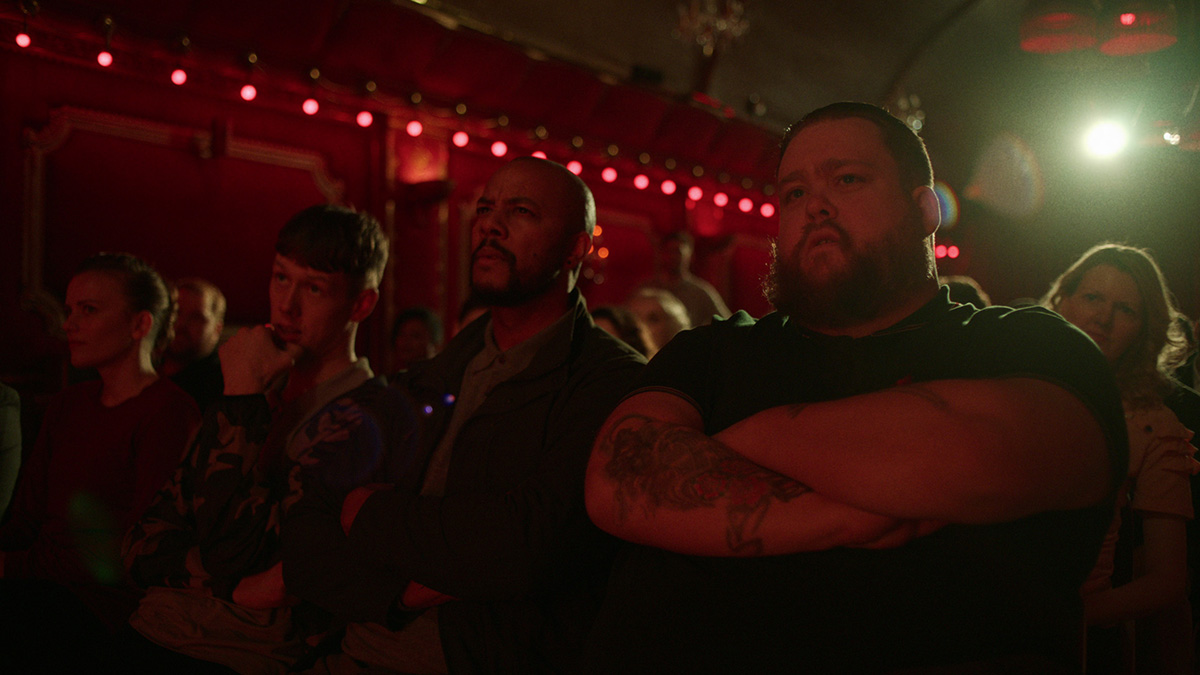
Nowhere was the red motif more pronounced than in the apartment in the much-discussed Episode Four in which Donny finds himself in a compromising position with another character.

Monday, 10 June 2024

Luma Partners: Big Tech Is Supercharging AI (and Challenging Traditional Media in the Process)

NAB

article here

In the last year, Meta, Amazon, Alphabet and Microsoft have each grown by more than half-a-trillion dollars in terms of market capitalization and they’ve done so by shedding jobs and supercharging efficiency with AI, according to investment bankers Luma Partners.

In a new report, Luma also says Big Tech is poised to remove live sports from linear TV’s grasp and with it hasten linear’s decline.

“Stock prices getting cut in half in 2022 was a wake-up call for companies to focus internally,” Luma Partners CEO Terence Kawaja said in a presentation of the company’s “State of Digital” report. “Whether big tech or independent Ad Tech and MarTech companies, everyone improved significantly across the board in the back half of 2023 versus the back half of 2022.” 

And they did it better than traditional media companies.

Big Tech and Ad Tech companies have righted their own ships by ruthlessly cutting jobs (Amazon slashed 16,000; Microsoft 15,000, Google 10,000 and Meta 20,000 jobs between January 2022 and March 2024), eliminating non-core programs, and most significantly rolling out AI products.

“In fact, when everyone else was talking about AI, Big Tech was going to market with AI products and achieving massive results with them.”

The deeper pockets of Big Tech are necessary in order to maintain an edge with AI, says Luma.

Google, Microsoft and Meta alone are expected to spend close to $400 billion on capital expenditures between 2023-2025. The majority of this is expected to be for infrastructure and development for AI initiatives.

Luma describes AI as “like a utility” and a “game for very, very large players,” advising that rival companies in media, for example, can’t cut their way to growth and sustained innovation.

“While the big tech players are using their balance sheets to fund AI developments, we believe M&A is going to be necessary component of strategy for others to reinvigorate growth going forward.”

The banker also has its eye on Connected TV, noting that tech giants are all investing heavily in live sports — which it calls “the Achilles heel of linear TV.”

Big Tech will make its larger wallets evident in the bid to win live sports rights.

“It’s increasingly becoming a mismatched fight between tech and media companies. It’s inevitable that when these [sports] contracts get renewed, they’re going to go to big tech. That will be the instigator towards an inflected decline of linear.”

Ultimately, media companies need to successfully transition to streaming and Luma doesn’t think much of their efforts so far.

“Media companies were in the B2B business, and they are now forced through streaming to get into the direct-to-consumer business,” said Conor McKenna, Senior MD at the company. “They don’t really understand that business, and you can see it from the churn.”

Companies like Comcast, Warner Bros. Discovery and Disney “are having to reacquire their customers two, three, sometimes five times per year,” says McKenna. “There are lower ad loads and the loss of affiliate fees. How have they responded? By re-bundling, wholesaling and consolidation.”

CTV though carries an opportunity to reverse those fortunes. CTV, McKenna notes, brings digital attributes to the big screen “so that we can have all the kinds of capabilities around targeting, precision, and performance that we do in digital, applied to TV.”

The other opportunity is to democratize TV spend. The cost of advertising on broadcast TV has historically excluded all but the largest brands.

“The real opportunity here is to go to the long tail of smaller and more performant advertisers,” he says.

“That will build a substantially better business model with more operating leverage just as tech companies have done with millions of small advertisers, and that we believe will bring a lot of health and vigor to CTV.”

This will come with new ad formats beyond the standard 15 and 30-second spots. Innovation around interactive, shoppable, pause screens, and even product placement with AI “is going to bring new blood to the CTV ecosystem.”

Luma points to the role that AI will have in ad-tech and advertising on CTV in particular, suggesting it will have a positive impact on creative ad forms.

“We believe we’re at an inflection point with AI that will see more focus on creative,” said Kawaja.

“Software that assists with data, workflow, and media optimizes for efficiency whereas for creative and content, it’s software that optimizes for effectiveness,” — and that will drive better outcomes.

Luma also believes that AI has the potential to reinvent search and even websites.

“Who needs to put data on a website that consumers never navigate to if large language models will find and provide the answer?”


Doug Shapiro Has Four Scenarios for GenAI in Hollywood (and Honestly, None of Them Are Awesome)

NAB

article here

The ability for GenAI to generate a movie from scratch has been in the back of Hollywood’s mind, but remained a future prospect. Executives are being urged to think again by Doug Shapiro, an analyst whose track record includes anticipating the rise of Netflix.

“The future is you’re going to have holistic platform where you can start with an idea and end up with a movie. AI will solve the video problem,” he told a Media, Internet and Communications Conference hosted by research firm and Moffett Nathanson.

“I thought this process was going to happen over the next five to 10 years, and now I think it’s probably more like three to five.”

One reasons why he says he misjudged the pace of AI’s impact on media is the exponential scale at which large language models advance.

“As the size of the training [data] set goes up and the number of parameters goes up, and the amount of compute goes up, the loss rate of these things continues to fall. Basically, regardless of the model architecture itself, scale solves problems,” he says. “I didn’t appreciate that.”

There are huge implications that arise from this and Studios as currently constituted are not best place to survive them, Shapiro warned: “AI is more of a threat than an opportunity.”

Previous disruptive forces, such as the impact of streaming on distribution, took a lot longer to come about.

“You had to build out broadband infrastructure. People had to adopt broadband, people had to adopt streaming,” Shapiro points out.

But now YouTube is the number-one streaming TV service in America, if not the world. That upsets the whole apple cart of studio economics.

“If there was a great AI-enabled show on YouTube tomorrow, it could be the number-one show in the US tomorrow night,” Shapiro claimed.

Studios are stymied in their ability to move with the pace of AI. That’s because of “an incredibly complex ecosystem in Hollywood,” and a fear at the executive level of rocking the unions by introducing AI too fast and too far.

“All of the studios are taking AI very seriously but they are very leery of doing anything that would be perceived to reduce labor demands.”

In addition, Shapiro says, studios are in no position to force talent, particularly creative heads like directors, to use AI to cut costs.

The result is a piecemeal approach to using AI in areas like localization, concept art or VFX which may create 10-15% savings, in Shapiro’s view, while outsiders adopting AI wholesale “and have the potential to see many more dramatic savings than that.”

He is not saying that efficiencies can’t be made, and picks out animation is a genre likely to be the first to change.

Former Disney and DreamWorks chief Jeffrey Katzenberg has said that AI can eliminate as much as 90% of the cost of making an animated film, and Shapiro doesn’t disagree.

“I think animation is one of the first places you’re going to see AI, both because of the labor demands and because the bar is a lot lower if you don’t have photorealistic humans.

“If you have a talking cat or something, then it’s a lot easier to do. There’s no uncanny valley with cartoon cats.”

But AI will also see slash the cost of blockbuster live-action movies. Shapiro does the math and reckons the 15-25% of average movie budgets are allocated above-the-line costs, 50% is below-the-line, and the remaining 25-35% is post, most of which is VFX.

“If we assume that you still need all of the above-the-line creative talent, that means that the rest of that is up for grabs, seventy-five to eighty-five percent. And right now, if you take the average budget, when you figure out just the below-the-line and post costs, it’s probably like $1 million a minute for most big movies,” he calculates.

“The question is: over time, does that cost converge with the cost of compute? Could that be $100,000 or $10,000 or $10 a minute? I think that’s kind of the trajectory. That’s what happens if you bring Moore’s Law to this, as opposed to rising labor costs.”

Stepping further out even that above-the-line talent — your Tom Hollands and Zendayas — are under threat, if that’s what the audience wants.

“There are four scenarios [for] how much AI consumers will accept. It’s not a technological issue, it’s a consumer acceptance issue.”

Scenario one is that there’s some arbitrary level of AI that people don’t like. Shapiro thinks we can dismiss that because VFX has taken over the film business and people still go see Guardians of the Galaxy.

Scenario two would be that people draw the line at artificial humans. He thinks that’s possible.

Scenario three is that consumers draw the line at artificial ideas — that you need to have a “human in the loop” because the story is supposed to evoke an emotional response.

“And an LLM [large language model] may understand the semantic relationship between tokens, but it doesn’t understand emotions. So, will you always need a human to be able to overlay their own judgment on what is emotive or not?”

The last scenario is that there is no line. “In that case you just have this dystopian doom loop of infinite AI generated content, which does not sound like a fun place to live.

Shapiro then thinks that we’re going to fall somewhere between scenarios two and three.

“You’re still going to need real humans for a lot of stuff and you’re still going to need some kind of creative overlay, some human to apply their judgment.”

Disruption is inevitable and it will come from the bottom up. A loose analogy is Pixar’s impact on the animation industry. He says, “It really took Pixar coming in with the CGI Toy Story to shake up the industry and herald the end of hand-drawn animation. The studios are probably going to be mostly dragged kicking and screaming into this world.”

Studios do still have some aces up their sleeve if they play their cards right.

“There’s going to be such a volume of crap. The vast, vast majority of AI content is going to suck.”

Execs have to work out what is still scarce and therefore has value as content itself becomes infinite. The answer might be IP, content libraries, and the ability to market, to create stars, and the ability to foster fandom.

“If you were to create a fine-tuned AI model that was trained on your own content, how quickly could you spin up new iterations of your existing library?” Shapiro asks.

“The business of making content is getting riskier. Studios manage their capital like a private equity investor, but we’re in a venture capital world. You need more swings at bat, at lower cost.

“You need to give the talent more equity. You need to use the network as a focus group, not as a marketing tool. You have to seed stuff onto the network, see what works, and then kill the stuff that doesn’t work and feed the stuff that works.”

Technology and development should work in lockstep, “not the technology guys in the basement” Shapiro said. “You have to really embrace these tools. I think it’s going to require a lot of cultural change in a very short period of time.”

No-one is immune, not even Netflix. Shapiro thinks the arch disrupter could become a disruptee, although the streamer is more nimble to adopting change than other media companies.

“They changed the model once. They probably have more leverage to try to strongly encourage talent to use these tools. And because they do all this stuff cost-plus and they actually line item budget every single production, they’re better empowered to exert pressure surgically inside the budget.”

But what if by 2028 or 2029 good-quality AI content is appearing free to view on YouTube or TikTok? What if those companies decide to extend out the length of videos?

“Do people at some point query why they’re paying $35 a month for this walled-garden service which I don’t always watch?

Hence Netflix, Amazon, Apple and other are moving into live sports — a genre that can’t as yet replace actual humans with an AI bot.