Tuesday, 26 September 2023

A VELVET touch

advertorial in British Cinematographer 

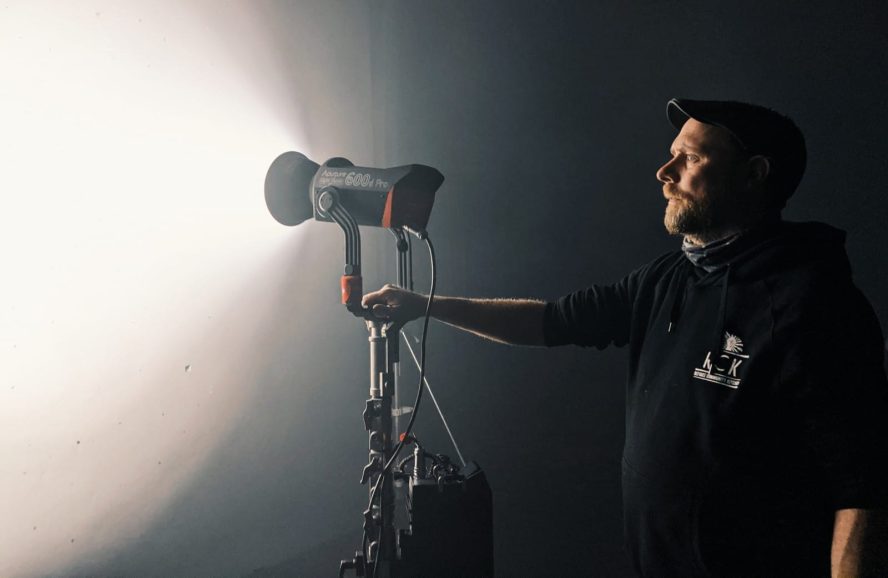
VELVET introduces two new fixtures this September to join it KOSMOS series of unique LED Fresnels. 

article here 

VELVET has been a reference for LED lighting in cinema since two Spanish DPs (Javier Valderrama and Toni Hernandez) founded the company in 2008 in order to work with the light they dreamed of.  

VELVET has the best lumen/watt ratio of the industry. The efficiency and quality of our luminaires are appreciated by hundreds of cinema professionals for their very low power consumption and high performance. 

Known for its technical innovations, Velvet was one of the pioneers in throwing the light placing optics in front of the LEDs further than anyone else before. It created a full range of robust, IP54, sustainable and durable lights that are highly valued as a quality standard for displaying high colour performance with skin tones and shadings. 

Their product range has evolved into an ecosystem – called the RGB Ecosystem – which includes EVO colour soft panels; CYC, the asymmetric cyclorama lights; and the KOSMOS series. KOSMOS 400 is a real Fresnel light due to its 12-inch true borosilicate lens and its compact design is full of advanced features such as motorised zoom, connectivity, gels, and effects. 

As with all its luminaires, VELVET takes care to manufacture each one at our lab in Barcelona. Working with local suppliers and collaborators, it generates a lower carbon footprint, minimising the environmental impact of manufacturing. Its factory and office’s electricity is supplied by a green energy provider. 

VELVET is proud to announce the latest members of the family, the KOSMOS 200 and KOSMOS 1000.  

KOSMOS 200 

This unique fixture is equivalent to a 1kW tungsten Fresnel. It is based on the KOSMOS 400, with the half output power (which is equivalent to a 2kW) with a 10-inch true borosilicate Fresnel lens. 

It has the same COB (chips-on-board) of five colour LEDs, which gives it the best lumen/watt ratio with high TLCI (Television Lighting Consistency Index) and CRI (Colour Rendering Index) values. 

This a pure Fresnel with a motorised zoom that allows remotely controllable, full connectivity options, gel libraries, customisable effects, and all the connectivity of the current KOSMOS 400. It can be controlled locally via DMX-RDM, Ethernet and remotely via LumenRadio, WiFi and Bluetooth. 

The brand-new luminaire version is a bi-colour Fresnel with plus green/minus green adjustment and outputs equivalent to 5kW tungsten Fresnel.  It has a 14-inch true borosilicate Fresnel lens (versus the 12 inches of the KOSMOS 400). 

This new KOSMOS 1000 is a robust, cost-effective, powerful, and quality light source, intended for studio shooting. Next we will introduce a colour, waterproof, IP-rated version which will integrate with the rest all the KOSMOS Colour series for perfect colour spectrum and intensity harmony. 

These new luminaires combine all of VELVET’s know-how in cinematic lighting and complete the KOSMOS series at the top of the range.

All KOSMOS are compact, lightweight, and consistently reproduce in all colour modes. They are fully wireless controllable and have plenty of advanced functions to enhance your creative possibilities and speed up your shoot.  

KOSMOS is ready to shoot at 100% light output. It has an integrated plate for external standard camera batteries, making this series of fixtures the perfect light for every production need on location.  

Javier Valderrama, CEO and co-founder of VELVET, says, “Velvet proposes and develops innovative technologies to produce more energy-efficient luminaries, to give more creative possibilities and to speed up the lighting set-up and adjustment process.” 

Perfect pairings: DP and Gaffer

British Cinematographer 

The DP/gaffer relationship is one of the most crucial yet arguably one of the least recognised collaborations in filmmaking. More than an expert technician, the gaffer helps the DP to turn the director’s vision into reality. 

article here 

“They are a partner in crime,” says Greig Fraser ASC ACS, who worked with gaffer Perry Evans on projects including Snow White and the Huntsman, Zero Dark Thirty and Rogue One: A Star Wars Story and with Jamie Mills on Mary Magdalene, The Batman and Dune and Dune: Part 2

“Whilst I have very definite ideas when it comes to lighting, I’m not always an expert in how to achieve them. I need someone who I can bounce ideas off, who is more organised than me and someone who keeps up to speed on, for example, the latest dimmer desks and software. It’s not just where you put a light, it’s how many lights, will the rental house deliver, does it work with the budget, are they flicker free at high speed, or waterproof? The gaffer has to decipher all these requirements. 

“Lighting technology is much more complicated now that every fixture has got computers onboard with the power to change colour, strobe or synch with shadows or work in a virtual lighting environment. I also want to play with new technology, so I appreciate gaffers who are keen on pushing the limits of the tech and conceiving unconventional solutions.” 

The DP recalls telling Evans that he wanted to light Rogue One entirely using RGB LED. “He didn’t even flinch, but this was the first all-LED show. The ‘can-do’ attitude of your gaffer is important to a good relationship.” 

Mills got to know Fraser as a spark under Evans. “Ultimately, my job is to make the DP’s job easier,” he says. “I take as much of the responsibility for lighting off their shoulders so they can be comfortable spending more time with the director. Learning the script is key too; knowing it inside out gives you a much better understanding of the vision and look of the film.” 

David Procter BSC’s approach to lighting is to work collaboratively from the outset. “I like to discuss light quality and technical requirements rather than micro-managing fixtures and textiles. This way I can see what a gaffer brings to the table and be open to new ideas and techniques. As cinematographers, I feel we are on a journey of perpetual learning. On set, I favour a gaffer who stays close to me, calmly managing the set and delegating to their team.” 

He has enjoyed a 15-year collaboration with Sol Saihati and commends the gaffer’s “unwaveringly calm temperament” as being exactly what he looks for in all his crew. 

“Gaffers who don’t look at monitors probably won’t be seeing me again,” he adds. “I love collaborators, not mere technicians.” 

Rufai Ajala has worked as both gaffer and a DP on shorts and commercials and finds themselves in the unusual position of mentoring up-and-coming DPs as their gaffer. As DP they usually work with gaffer Kristóf Szentgyörgyváry and the young DPs they have worked with include James Dove, Aman K. Sahota and Natalja Safronova. 

Ajala says, “After a few years as DP I found myself in a position where I wanted to support new and emerging cinematographers. They might describe the lighting aesthetic they wanted but perhaps didn’t have the knowledge to translate that into a specific setup. I felt that I had the knowledge to help them do that.” 

Julian White has gaffed for Martin Ruhe ASC on films including The American and Midnight Sky. “I love working with Martin,” he says. “We have an understanding that after discussions I can just light, and he will say what he likes and doesn’t. It’s more a process of reduction and editing. It tends to be more about mood and colour not so much about the technology.” 

White has also worked with Haris Zambarloukos BSC GSC (Cinderella, Murder on the Orient Express) and shot commercials with Fraser and Hoyte van Hoytema ASC FSF NSC. 

“If you provide a service and/or a friendship that is invaluable to DPs you will become their right-hand person,” White says. “Working in film is all about shorthand. As I say to my team, ‘You have to try and think like me because I am thinking like the DP, and they are thinking like the director.’ It’s a pyramid that is pushing downwards and needs to be supported upwards.” 

As the years pass, professional relationships become friendships and, as comradery grows, shorthand develops from shared experiences. 

“We mutually learn the nuances of our regular collaborators,” says Procter. “Aside from aligned sensibility, it’s a true asset having a gaffer who’s anticipating possible requirements based on previous collaborations, be it a last-minute catch-light or additional negative fill. There’s been countless times where Sol has pre-empted something I may have missed.” 

Mills says of his relationship with Fraser, “I understand his lighting style and how he likes to work. It’s about staying one step ahead so that from day one I know what he needs before he asks for it. I am already in his head, if you like.” 

A bond naturally develops among a film crew when they spend weeks apart from their families on location, which is one reason why DPs like to work with the same teams. 

Mills spent nine months away from his young family in Budapest shooting Dune and another eight months away on the sequel. “It’s tough, especially when you mostly see them growing up on FaceTime, but it’s part and parcel of the job.”  

There’s no getting around the pressures of the job either. “There’s a trust that inevitably develops with the more situations that you live through together,” says White. “All relationships are based on a call and response and if somebody is not appreciative of what you do, it doesn’t always work out. Some DPs and gaffers shout at each other but they still work together. It’s a bipartisan relationship. You have to respect both sides.” 

Trevor Forrest describes his relationship with gaffer Justin Dickson, with whom he has worked on I Am the Night, Manhunt and Genius: MLK/X, as a “brotherhood”. 

“Justin comes with his own ideas. We definitely butt heads, but the friendship is always there. We’re always trying to pull and tease out what is in front of us in the best way.” 

Dickson says, “What I love about Trevor is he cares about merging the ideas of the collaborators that are around him as opposed to imposing a singular vision on others. When you cut off everybody from the creative process you box yourself into a corner.” 

When it came to shooting MLK/X about two of America’s iconic figures, Forrest says his colleague’s insight into the Black community was invaluable. 

“I’m a white guy from Wells-next-the-Sea who only brings privilege. Justin (whose uncle marched with Luther King) had grown up in the Baptist South. When you bring someone on board with that depth of subject matter there will be a fizzing of energy.” 

It wasn’t so much the technical fine-tuning to achieve accuracy to period and character when lighting black skin tones so much as Dickson’s lived understanding of story that was valuable to Forrest. 

“I was able to call my mama up to ask what did this [scene] feel like. Trevor is expert at finding angles and lighting but with some stories it is less about seeing the characters or scene so much as about feeling them. That feeling is what we are trying to translate.” 

Scaling the ladder to Gaffer

British Cinematographer 

There remains no set route into film and TV production, especially in the craft grades. Looked at one way that means you can enter the industry from pretty much any angle, but those wanting to build a career in lighting will find many barriers in their path. 

article here 

“There are lots of people who love movie making but can’t get in because they don’t know the right people,” says gaffer Julian White (The Midnight Sky). “Most people get into the industry because their mates or member of family are doing it.” 

Chief LX Cullum Ross agrees, “There’s a lot of nepotism. There always appear to be opportunities in other department and fewer in lighting.” 

Jamie Mills started off at Lee Lighting in 1993 as a 17-year-old, one of the first kids to get a job there without having any relations “in the game”. 

“I stumbled into the industry by fluke,” he says. “I was just in the right place at the right time. I’d always loved film, just never thought about it as a career.” 

He started out wanting to be a regular domestic electrician and attended an open day at a local college that was doing aptitude tests. He happened to come top of the class. Talent scouts from Lees were watching and hired him as an apprentice on the spot. 

“After finishing the apprenticeship at Lees, I was sent to The Bill as a floor electrician. It was a great training ground. You learnt how to behave around camera, how to set flags, how to position lamps and the reason you were doing it. By the time I’d left four years later I was gaffering the show.” 

John ‘Biggles’ Higgins trained as an electrician in the 1970s and then went into further education, eventually ending up as an engineer on oil platforms in the North Sea.  

“With accommodation being in short supply on the rigs, we were sent home a lot on leave while another engineering crew took over. In that space between shifts I got a job in a small film studio in London, and I liked the workshop so much I stayed and never went back to the oil industry.” 

Sir Roger Deakins CBE ASC BSC gave Biggles his big break by inviting him to light 1984 – the first of 70+ credits including 1917 and Skyfall

White had an even more circuitous route to becoming a gaffer. He studied video performance in Liverpool and worked in the prop department on local soap Brookside. He left and rejoined the industry on a few occasions, never quite sure of where his more artistic sensibilities would fit in. It was in his thirties when DP Roger Eaton asked him to gaffer for a commercial for the charity Shelter. 

“It was the first time anyone had asked me what I thought of the frame, the composition, the look and feel. I also got paid more in one night than as a waiter.” 

Soon afterward he was part of the crew lighting hit TV series Band of Brothers, created by Steven Spielberg, and never looked back. 

What they each have in common is a lack of career advice and progress gained by learning on the job. Mills advises spending a year at a lighting company learning “thousands of bits of kit” as the most valuable use of one’s time when starting out. 

“No knowledge is a waste of time,” says Biggles. “Everything you learn has to be an advantage to you at some point.” 

That mantra is repeated by the experienced hands talking to British Cinematographer. There’s no substitute for practical experience with, well, practicals, but it can help to have the basics of electrical health and safety under your belt. 

“I get a lot of CVs from people wanting to come into the lighting department with degrees in filmmaking and photography,” Biggles says. “But, before they can aspire to go further in the lighting department, they need a very good grounding in electrical engineering. Often that means spending another three years training and learning about engineering and electricity. They need to realise they will be dealing with a very dangerous product.” 

Ross steers newcomers toward attaining City & Guilds Level 2/3 (courses can last up to two years but have lifelong value) and BS7909, the standard on how to design and manage temporary electrical systems. Any number of specialist courses including for moving lights, automation control, lighting data networks can be added on top. 

“Even with this, people should go get some experience with a local crew or lighting rental house. Demonstrate that you have the motivation, aptitude and staying power.” 

Qualifying as an electrician will give you essential health and safety awareness and provide the basics for managing power and plugging in lights won’t necessarily make you better at lighting. 

“If you’re good at managing people and practical logistics of organising crew, kit and positioning lights you can progress from spark to best boy, to gaffer,” says White. “However, you can be the best electrician in the world and still be useless as a gaffer. 

“All DPs will appreciate their gaffer making their process as easy as possible so they can concentrate on talking with their director and thinking creatively. The least you can do is be a facilitator and at best a creative collaborator too.” 

On bigger shows the gaffer will orchestrate where the DP wants certain lights to be positioned, but the actual fixing of the fixture is passed to the rigging gaffer. 

“Being a gaffer is a bit like being a racing car driver,” White says. “You don’t need to know how to fix the car. You need to know how to drive it. You can be qualified to the hilt and have no real understanding about why you are doing it. 

“You may know how to get the wiring right but lack empathy with the DP about diffusion and colour. The problem is finding the connective tissue between the technical and the artistic.” 

If you’re lucky the aspiring gaffer will be taken under the wing of a mentor. Ross credits a couple of mentors including lighting cameraman Andy Bell – “a brilliant people person who taught me how to light for the screen, how to look after kit, and to travel smart.”  

Mills worked for 16 years with Perry Evans beginning on Tomb Raider (2001). “Perry pushed me out as a gaffer. If there were any reshoots or additional photography he couldn’t do, he’d send me. If he had to step away from the floor, he’d stick me up front. And if there was a splinter unit going, he’d ask me to do it.” 

White calls for more mentorship and careers planning, even to explain to entrants what the essence of the job is and what steps you would ideally take to get up the ladder. 

Ross says all his experience comes “from working with different people in different countries on different types of production” but he has made it his mission to help mentor the next generation. 

As one of a handful of ScreenSkills mentors, his role “is to help explain the industry, dispel some myths, explain the structure of a dept and potential career progression and qualifications.” 

There are further steps to formalise the process. The ScreenSkills electrical trainee programme, for example, offers funding support to placements every year on productions with the aim of translating the opportunity into further employment. This is supported by the High-end TV Skills Fund, a pot of industry money that has only recently been tapped by lighting departments. 

“The greatest thing we can do for the next generation is on-the-job training, but funding is a problem,” says Ross, who tries to unlock access to training opportunities on his team when he works with streamers like Netflix. “You have to make the sales pitch to the production. Sometimes that works and, even if it is a box-ticking exercise, I don’t mind as long as we get new blood into the industry.” 

He adds, “With Bectu Lighting Technicians and other industry organisations, we are trying to reintroduce a training scheme [for productions]. It’s a work in progress but the idea is to formalise what the trainee will be paid, who they will shadow, and to agree with the production a structured set of experiences over the duration of production so that the trainee can walk away with an official ‘passport’ of what they’ve learned. By having an industry specific training, qualification and a simple verification process, crew and engagers will have confidence that qualified crew will be able to identify, and reduce risks, making film and TV sets even safer and more efficient.” 

Monday, 25 September 2023

AI to revolutionize sports broadcasting

IEC

article here

Artificial intelligence (AI) is breaking the conventional frame of broadcast production and transforming the fundamentals of content delivery and viewers’ experience.

In less than a year the torch will be lit at the Olympic Games in Paris with record breaking audiences expected to watch the competitions online. The International Olympic Committee’s broadcast services arm, OBS (Olympic Broadcasting Services) has been experimenting with new digital technologies and in 2024 promises a visual and data-rich feast.

The previous Olympic games in Tokyo 2020 proved to be a watershed moment in the history of Olympic broadcasting with digital output up 34 % on  the previous ones in Rio.  It is part of a wider trend in which the distribution and consumption of TV is shifting from broadcast TV to streaming over the internet.

With broadcasters reluctant to invest further in the (satellite or internet bandwidth) infrastructure needed to lift picture quality to 4K ultra high definition (UHD) resolution, attention has turned to using innovations in data and artificial intelligence (AI) to bring the sport closer to home.

The IOC’s ambition, unchanged for a decade but thrown into greater urgency during the Covid-affected 2020 Tokyo Games, is to deliver “the most realistic experience one can get from viewing a sporting event without actually attending in person.”

Using the power of data

Data from Paris Olympics venues will be used on screen to inform and engage fans and behind the scenes to speed up content production. Trialled at Tokyo and again at the Winter Olympiad in Beijing, the IOC will expand the use of specialized algorithms – or AI – applied to data in Paris.

This includes an Automatic Media Description system which combines existing data from the TV signal with image recognition based on an athlete’s bib. This will be used to make the process of tagging footage for use in media production much more efficient.

“If we were to tag all our content, it would require an incredible effort and a large number of human operators,” explained OBS Chief Technology Officer, Sotiris Salamouris. “By using trained AI systems, this could be accomplished in a fraction of the time (and cost), while increasing both the speed of searches and the accuracy of the search response.”

The same system can be used to customize content for broadcasters, or even for individual fans, wanting to view the action of a particular country or athlete.

In Paris, AI-based motion tracking technology will help commentators and viewers keep track of the position of the athletes during events like marathon, road cycling, triathlon and canoe sprint. This has proved tricky before given the nature of the course terrain.

IEC Standards can help

ISO/IEC JTC 1/SC 42 is the joint IEC and ISO committee that develops international standards for AI. The committee works on horizontal standards that provide a foundation for developing AI solutions across a wide and diverse set of industries and applications. For example, ISO/IEC 23894 shows users how to manage AI-related risks effectively in order to achieve objectives and improve performance.

Sport climbing returns after making its Olympic debut in Tokyo and to help audiences understand the challenges involved, OBS will use augmented reality technology to overlay live shots of the wall with virtual ones to display information about the holds, angles and routes.

IEC is paving the way for the use of virtual and augmented reality technology in a variety of different fields. IEC TC 110 prepares standards relating to VR viewing, including VR, AR and MR eyewear displays, for instance IEC 63145-1-2. The IEC and ISO have formed a joint subcommittee, SC 24, which works on the standardization of interfaces for information technology based applications relating to computer graphics and virtual reality.

5G, cloud and biometrics combined

Alibaba Cloud is the IOC’s official cloud services partner and will provide cloud-based broadcasting, big data analytics, logistics support and  tracking of athletes’ performance on the field. Its contract runs until 2028 at the Summer Games in Los Angeles.

In Paris, expect this to include biometric data such as the heart rates of competitors in archery. From cameras focussed on the athlete’s face, the system analyzes slight changes of skin colour caused by the contraction of blood vessels. Audiences will be able to chart the adrenaline rush experienced by archers as they shoot their arrow in an on-screen graphic.

Also in Paris, expect greater use of 5G wireless technology to open up more of the same real-time performance data from other sports. While data from sensors can also be gathered by other types of wireless technology, 5G can offer ultra-high data collection speeds with very low latency.

Although the Olympic Games tends to push the technology boundary more than any other live broadcast, similar innovations are being deployed across elite sports.

Other sporting events use AI

At the Wimbledon tennis championship this year, raw ball and player tracking data was ingested into an AI-driven software from which a range of new data points were extracted.

“To date, all tennis data has centred on the first and last hit of a rally, but you could have 42 shots in a rally and lack the ability to capture every shot – until now,” explains James Muir, Wimbledon’s Broadcast Technical Manager.  

“In a game as nuanced as tennis you want to use data to help viewers understand, for instance, why a forehand won the point, or how the tennis champion Alcaraz is able to apply extra spin to a slice backhand,” he adds.

Automation is on the cusp of making significant inroads into sports production. Indeed, the most high-profile events are already benefitting from AI-empowered tools. At the Qatar World Cup, FIFA used semi-automated offside technology in support of match officials to help them make faster, more reproducible, ideally more accurate, decisions.   

Leading soccer clubs are adopting AI/ML as training aids. An AI player tracking software is being used by AFC Ajax to help coaches make snap analysis during training sessions or matches.  

Fully automated sports production, including remote operated cameras and the software to automatically record and cut video, offers huge cost savings in terms of equipment and technicians for sports like US college basketball or second-division Scottish Professional Football which do not have mainstream media rights partners.

AI not quite ready for all applications

Computer vision techniques are not yet smart enough to understand every sports action. Sports with predictable movements, like track cycling, are relatively easy to automate and so too are distinct moments in soccer (like ‘goal’ or ‘red card’ or ‘corner’) for an AI to track, record and playback as a sequence. It is the myriad of other permutations which prove harder to programme. 

“For example, if there’s an injury to a player the AI will have no clue about what’s going on,” says Michel Bais, Chief Product Officer at a US developer of automatic sport production systems. “The AI might instead start filming the goalkeeper because that is where the ball is at that time. After 30 seconds it may realize something is wrong but not know how to correct it.” 

Developers of AI sports production solutions believe that their technology will be used alongside experienced human crews for some time. Familiar production roles will change to accommodate the growing use of AI. An ‘AI production technician’ might be someone who installs the technology onsite, ensuring the data is processed correctly. An ‘AI production director’ might be responsible for supervising the AI generated output of a highlights reel, perhaps adding a more human emotional layer to the presentation.  

“Lots of time is needed to train AI to be good enough to be relied on for top tier programming, so by default, it’s quite expensive,” says Bais. “You’d need an innovator like Sky or Fox Sports to put AI front and centre.”  

During the Tour de France this year, a 3D graphic helped show viewers the gradients faced by the peloton that are often so tough most people couldn’t walk up it let alone cycle it. “This is where the audience expects to go in sport,” said Scott Young, SVP content and production at Warner Bros. Discovery Sports Europe. “They want to be on the field of play. They don’t want to be in the grandstand anymore, from a television viewing perspective. Trying to bring the enormity of what the athletes are actually up against into our studio is the biggest challenge we face.”


Wednesday, 20 September 2023

Behind the Scenes: Rugby World Cup

IBC

With a year to go before the Olympics come to Paris, France has the opportunity of a major sporting spectacle in hosting the Rugby World Cup 2023 and anticipation of a possible home triumph is building.

article here

“This reminds me of the excitement in the build-up to 1998 when France hosted the football World Cup,” said Julien Bertin, Executive Producer at HBS, told IBC365. “If France performs on the pitch anywhere near as well as [the team who won in 1998] the more the excitement will build; this is a huge opportunity for France as a country.”

In the four years separating the 2019 and the 2023 Rugby World Cups, World Rugby has worked hand in hand with its host broadcaster, HBS, to evolve its coverage to add new specialist cameras to the standard camera plan. Coverage this time will feature footage from cable-cameras for every match, drones, helicopters, and cine-style cameras.

“It has been a pleasure to work alongside HBS with the planning of RWC 2023 where we feel the broadcast of rugby will be shown in an innovative and exciting way bringing viewers closer to the game than ever before,” stated Steve Jamieson, World Rugby Executive Producer.

Behind the Scenes: Rugby World Cup - Mirrorless Cameras

There has been a surge in the use of compact, mirrorless cameras that capture a shallow depth of field as part of a live sports broadcast. At the Qatar World Cup, which HBS produced for Fifa, they deployed a Sony FX3 camera with RF connectivity at each game.

“The added cameras bring a real editorial enhancement,” Bertin emphasised. “We felt it was important to include them in our coverage. Rugby has lots of stops in play where you can use them. We will try to be more immersive with the players starting from their arrival off the bus perhaps captured in slo-motion so we can see [Antoine] DuPont or [Owen] Farrell looking relaxed or focused.”

Behind the Scenes: Rugby World Cup - Cinematic coverage

Cine-style shots will be used extensively in the warmups and in the tunnel prior to kick-off where World Rugby wants details of the player’s faces. This will also be applied during the players’ line up and the national anthems.

“The national anthems can be very emotional, so we want that cinematic focus on a couple of players. South Africa captain Siya Kolisi, for instance, often closes his eyes and cries during the national anthem so we want to go there since those moments create so much empathy.”

Following a try, the cine-style camera operator will be allowed onto the pitch to film the scorer’s joy. It is all about wanting to bring the viewer into the stadium and onto the field of play.

Pool matches are covered with 25 cameras, upped to 33 for the quarter finals, 38 for the semis and 39 cameras (including heli) at the final at Stade de France. Two cine-style camera (one per team) will operate from the knockout phase.

For the first time, two cameras will be filming inside the Team Match Official (TMO) cabins, bringing viewers closer to the heart of the decision process.

OB suppliers include trucks and crew from French companies AMP, EMG ad well as NEP UK.

Behind the Scenes: Rugby World Cup - Overhead tactical shots

Cable-cams are being introduced for every venue and every match. The technology’s use in rugby is perhaps more instrumental than for any other sport (bar NFL). “You can place it overhead to see tactical movements, you can position it on the line out and at kick off and we’ll be using it for every penalty kick and conversion kick,” said Bertin.

“Again, relevance is the key word here. We will use the cable-cam to follow the trajectory of the ball from behind the flyhalf as they kick toward the post. We feel that is the best angle for the audience to know for sure whether the ball has crossed the try line.”

Coverage of pre-match warmups will also benefit from the aerial shots. World Rugby and HBS hope that player familiarity with cablecams will help them relax and interact with the camera, “a gold mine for the broadcasters” when that happens, said Bertin.

The technology is also important to convey the experience of spectators at the match reacting to what is happening on the field. “The idea is to show to viewers at home what the atmosphere is at the stadium.”

Similarly, and for the first time at a Rugby World Cup, drones will play a prominent role. Among its applications here is to connect the atmosphere of fans surrounding and arriving to the stadium, with the game itself.

“We decided that it was important to provide context to any game to offer a more immersive coverage for the viewers; we’re not just showing the stadium and the pitch, but also the fans in the city, and the whole country as one big celebratory event for the Rugby World Cup.”

Behind the Scenes: Rugby World Cup - UHD not HDR

All coverage is being produced natively in UHD (some cameras such as slo-motion being up-rezzed from HD) as well as offered in 1080i. NHK is one taker of the UHD feed but in the UK, ITV is broadcasting HD. None of it is HDR, which is perhaps surprising given the advance into this format made by other sports like soccer.

In terms of digital, Rugby World Cup France 2023 has taken another leap forward, with the addition of a digital first methodology. Whereas in 2019 digital output was largely post-produced, a digital first initiative will see dedicated teams at each game shooting content pitch-side on mobile phones with the clips turned around in near live and stored on a portal for broadcasters to access.

“There’s a huge increase in dedicated digital driven by broadcasters and World Rugby demand,” said Bertin. “That said, live linear remains the core content production which all other content outputs use as their first reference.”

One thing rugby has in its favour over soccer is the respect given to match officials. In particular, the role of the on-field referee will be given prominence by HBS when it comes to communicating decisions.

“The Match Official (MO) is our number one commentator when it comes to the rules. We ask our commentators to go quiet when the Match Official is talking live. The MO has a very simple, clear form of verbal communication. Is it a try or not? Is it a knock on? For us, this is gold and it’s why we put even more emphasis on the audio of the match official.”

While the Television Match Official (TMO) video review returns with a similar on-screen workflow, new for this World Cup is the Bunker system of adjudicating red cards. The bunker itself, with officials, is centralised at the International Broadcast Centre at Roland-Garros in Paris, instead of at stadiums.

“We’ve created new graphics to indicate that a bunker review is in process and, similar to TMO, when there’s a decision the match official will speak, and we will see an angle of the referee announcing whether it is a red or yellow card and then show the angle that has triggered the decision.”

They won’t, though, carry the chest-high ref cam which has been used in other test matches, with World Rugby deeming this unnecessary.

While HBS, a company with its operational headquarters in Paris, treats every project and sport with equal balance and professionalism, there’s no doubt that their intimate knowledge of events on home soil has handed them a bonus point.

“We know the technical zones and cable paths and camera platforms so from a practical point of view we know what works and what doesn’t and how the culture works to get things done,” said Bertin. “I feel proud to play my part in making this tournament a success, as we all do at HBS. It would feel a missed opportunity not to give it 500%.”

Should We Learn to Stop Worrying and Love AI? Ummm, So… Experts Say No.

NAB News 

A growing share of Americans are worried about the role artificial intelligence is playing in daily life — and they have every right to be concerned, according to two new studies from Pew Research Center.

article here 

More than half of United States citizens say they feel more concerned than excited about the increased use of AI, according to Pew’s poll of 11,201 US adults, which ran from July 31 to August 6, 2023. That’s up by 14 points since the last such survey in December.

For instance, 53% of Americans say AI is doing more to hurt than help people keep their personal information private. The survey supports previous Pew analyses, which found public concerns about a desire to maintain human control over AI and a caution over the pace of AI adoption in fields like health care.

Although AI’s impact remains vague in general public consciousness, concern has reached fever pitch among academia, policy makers and scientific communities where there are deep concerns about people’s and society’s overall well-being. They also expect great benefits in health care, scientific advances and education — with 42% of these experts saying they are equally excited and concerned about the changes in the “humans+tech” evolution they expect to see by 2035.

In sum, the 350 experts canvassed by the Pew Research Center have great expectations for digital advances across many aspects of life by 2035 but all make the point that humans’ choices to use technologies for good or ill will change the world significantly.

Andy Opel, professor of communications at Florida State University, frames the dichotomy in comments for the report.

“We are on the precipice of a new economic order made possible by the power, transparency and ubiquity of AI. Whether we are able to harness the new power of emerging digital tools in service to humanity is an open question.”

We’re on the cusp of making those decisions right now.

The experts who addressed this fear wrote about their concern that digital systems will continue to be driven by profit incentives in economics and power incentives in politics. They said this is likely to lead to data collection aimed at controlling people rather than empowering them to act freely, share ideas and protest injuries and injustices. They worry that ethical design will continue to be an afterthought and digital systems will continue to be released before being thoroughly tested. They believe the impact of all of this is likely to increase inequality and compromise democratic systems. 

A topmost concern is the expectation that increasingly sophisticated AI is likely to lead to the loss of jobs, resulting in a rise in poverty and the diminishment of human dignity.


Reliance on AI for the automation of story creation and distribution through AI poses “pronounced labor equality issues as corporations seek cost-benefits for creative content and content moderation on platforms,” says Aymar Jean Christian, associate professor of communication studies at Northwestern University in the report. 

“These AI systems have been trained on the un- or under-compensated labor of artists, journalists and everyday people, many of them underpaid labor outsourced by US-based companies. These sources may not be representative of global culture or hold the ideals of equality and justice. Their automation poses severe risks for US and global culture and politics.”

Several commentators look for the positives of digital advances and in particular point to the democratizing and socially levelling effect that this might have.

“The development of digital systems that are credible, secure, low-cost and user-friendly will inspire all kinds of innovations and job opportunities,” says Mary Chayko, professor of communication and information at Rutgers University. “If we have these types of networks and use them to their fullest advantage, we will have the means and the tools to shape the kind of society we want to live in.”

Yet Chayko has her doubts. “Unfortunately, the commodification of human thought and experience online will accelerate as we approach 2035,” she predicts. “Technology is already used not only to harvest, appropriate and sell our data, but also to manufacture and market data that simulates the human experience, as with applications of artificial intelligence. This has the potential to degrade and diminish the specialness of being human, even as it makes some humans very rich.”

Herb Lin, senior research scholar for cyber policy and security at Stanford University’s Center for International Security and Cooperation writes, “My best hope is that human wisdom and willingness to act will not lag so much that they are unable to respond effectively to the worst of the new challenges accompanying innovation in digital life. The worst likely outcome is that humans will develop too much trust and faith in the utility of the applications of digital life and become ever more confused between what they want and what they need.”

David Clark, senior research scientist at MIT’s Computer Science and AI Laboratory says that to hold an optimistic view of the future you must imagine several potential positives to come about.

These include the emergence of a new generation of social media, with less focus on user profiling to sell ads, less emphasis on unrestrained virality, and more of a focus on user-driven exploration and interconnection. 

“The best thing that could happen is that app providers move away from the advertising-based revenue model and establish an expectation that users actually pay,” he asserts. “This would remove many of the distorting incentives that plague the ‘free’ Internet experience today. Consumers today already pay for content (movies, sports and games, in-game purchases and the like). It is not necessary that the troublesome advertising-based financial model should dominate.” 

A whole section is devoted to expert thoughts on the impact of ChatGPT and other generative AI engines.

Author Jonathan Taplin, echoes many in the creative community, “The notion that AI (DALL-E, GPT 3) will create great ORIGINAL art is nonsense. These programs assume that all the possible ideas are already contained in the data sets, and that thinking merely consists of recombining them. Our culture is already crammed with sequels and knockoffs. AI would just exacerbate the problem.”


Tuesday, 19 September 2023

AI at IBC 2023: The GenAI Is Out of the Bottle

Streaming Media

article here

A few years ago, when the industry first began to take serious notice of AI, the technology was really an application of machine learning. The progression and development of the tools and apps since then has been phenomenal, which is why SMPTE president Renard T. Jenkins told the International Broadcasting Convention (IBC), that the M&E industry is only just starting on its journey through a decade of massive change.

Actually, industry experts expect the next 20 to 40 years of developments in media and entertainment to be dominated by conversations around this technology. It was certainly the pervasive trend at the IBC trade show permeating all corners of conference and show floor. Skeptics might point to 2023 as the zenith of the AI hype cycle and that like stereoscopic 3D, Virtual Reality, the metaverse, and Web3, AI will soon fade into background.

It doesn’t really look that way at this time, although discussions are now being framed with a little less hyperbole and a little less fear and more practical assessment of the ways this multi-faceted technology can be best introduced and managed across the value chain.  Media companies are beginning to explore Generative AI not to create entire new movies or shows, but to personalize content for users and improve the efficiency of media production.

There weren’t many AI cynics at IBC, with most execs choosing to emphasize the view that AI is but a tool, not a usurper of jobs.

AI's Intelligence Revolution

“Google is convinced that AI is one of most important inventions of the 21st Century,” said Dex Hunter-Torricke, Head of Global Communications & Marketing - Google Deepmind in a keynote.

Likening GenAI to the industrial revolution and the information revolution he said the transition to the “intelligence revolution” would enable a new wave of creativity.

“GenAI can have a huge impact on how we make content, access information and synthesize data for great insights,” he declared.  “AI essentially reduces the friction between accessing, sharing, and collaborating with information.”

Addressing the thorny issue of whether AI will replace humans in the workplace Hunter-Torricke countered that this view “undersells the value of people.” He said, “people naturally want to see more creativity from humans and AI will amplify and build on this. We will see a lot more content where AI plays a role, but humans are critical to the process by adding value.”

He said Google was looking decades ahead to the next level of AI or “artificial general intelligence … This is where AI advances to a much more sophisticated almost human level intelligence and tools that are vastly more powerful than today.”

Data Drives AI

In another session, Raghvender Arni, Director, Customer Acceleration Team at AWS posed one of the bigger questions for the creative industries. “Data is the oil that really pushes AI forward,” he said. “But once you’ve created the data, who owns the copyright for it?”

Amazon has been engaged in ML and AI for over two decades and its practical applicability in the media entertainment space is deemed very important to the business, perhaps because of all the cloud processing capability AI requires.

“There will not be one foundational model to rule them all,” said Samira Bakhtiar, Director of Global Media & Entertainment for AWS. “The ability to leverage APIs to access foundational models, as well as to leverage open-source solutions, is going to be paramount.”

“We want to ensure that your data is yours,” she added. “It’s protected. It’s proprietary. It’s your IP, you should be the one that has control over it.”

Quincy Olatunde, VP, Products, DTC at NBCU’s Peacock TV, agreed.  “Performance comes down to the quality of the data and how it is sourced,” he said. “Businesses should be aware of the potential risks they may expose themselves to, while ethical responsibility remains a big factor.”

Philippe Leonetti the boss of video security and management specialist Viaccess-Orca (VO) said it best. “Everyone can use ChatGPT. The point is how you apply it.”

Azure OpenAI and Firefly

At IBC, VO touted a partnership with Microsoft’s large-language model (LLM) Microsoft Azure OpenAI.  Leonetti continued, “To optimize AI performance you need data but having data or analytics or cloud is not sufficient. You have to know what you want to achieve, and you have to be expert at using it.”

In the last few weeks Adobe has released Firefly, a suite of AI models for GenAI, such as text to image, which are “ethically sourced” from the public domain or from data Adobe has the rights to exploit.

“We can assure creators that using Firefly is trained on high-quality content,” Kylee Peña, product marketing for Adobe told the IBC audience.

Adobe is also a founder of the Content Authenticity Initiative, a cross-industry community uniting in a standards approach to how AI is deployed. “The idea is to surface what is going on with an image, where it was trained, how it was altered to combat disinformation and increase transparency,” she said. “We’re seeing camera manufacturers joining us in this cause to protect the creative and give consumers all the information they need to make informed decisions.”

The company said it was also introducing “Do Not Train” credentials for artists to tag their content if they do not want it used by an AI bucket.

Automation and Personalization

Lewis Smithingham, SVP of Innovation & Creative Solutions at Media.Monks, was among several speakers to emphasize the potential of AI to automate and personalize media. He described the state of AI right now as “the worst it will ever be,” but that AI would “be the death of monoculture” and birth new “microcultures and subcultures that allow people to personalize their content.”

Content would no longer be created and programmed based on demographics like age or location, he said, but on terms such as individual identity. “AI gives us the opportunity to create personalized content at scale,” he said.

Bakhtiar said that if organizations are looking to gain a competitive edge, they should think about how to leverage the vast quantity of data they have at their command to create “hyper-personalized, hyper-localized experiences.”

John Footen, MD of Media & Entertainment at Deloitte, also pointed to personalization of content as something that will be of “dramatic importance” in future. “One of the roles of GenAI might be to create an avatar of yourself, so you can then ask that GenAI to show content to match your mood and social situation,” he said.

Avid’s CTO Kevin Riley urged the industry to embrace AI, much as his own firm has done in an extensive alliance with Microsoft.

AI for Creatives

“Don’t be afraid of this,” he said in yet another AI session at IBC. “The cloud was similarly viewed as a massive disruptor, but what has happened already is that there are a bunch of new jobs being created—and the same thing is going to happen with AI.” 

Anthony Guarino, EVP Global Production and Studio Technology at Paramount agreed. “It’s not about replacing existing creative processes but about putting AI tools in the hands of creators and allowing them to use the tools as they see fit for the job,” he said.

Accenture’s Global Communications and Media Lead Any Walker predicted that by 2026 all creatives would be using GenAI to enhance media workflows.  Across content creation and production, Generative AI can act as a “creative co-pilot,” Walker told the IBC Daily

“The technology can take distribution and commercialization?to the next level, elevating how media companies can distribute content to wider, more targeted audiences, and manage and monetize assets more effectively,” he said. 

AI and Sports Customization

In reality, much of the conversation about AI remains just that—talk (or hot air, if you like). One sector where it is making inroads as a practical solution is in helping producers and rights holders customize sports events.

Video transport systems provider LTN is already using the technology to make sports more appealing to younger generations, said Rick Young its SVP, Global Products. Examples include swapping in and out different presenters or bespoke commentary.

Vinayak Shrivastav, Founder & CEO of AI-powered highlight generation platform Magnifi, reported that customization of sports content is already playing an important role in India “particularly with the younger crowd which wants to follow different layers in the content.”

Just ahead of the show, Magnifi announced a partnership with Grabyo aimed at delivering a “human-centered video automation workflow” for sports content creators.

This links Magnifi’s computer vision technologies with Grabyo’s live production and distribution platform to give sports producers the ability to capture, edit, and publish highlight clips from live sports broadcasts at speed, and at scale; “It’s going to be fascinating to see how many different versions of the same content can be created,” Shrivastav said.

Oddly it was Google’s Hunter-Torricke who struck the only note of caution when addressing the existential threat from AI. “We need to deal with near-term potential dangers from AI—such as misinformation—from bad actors whether individuals or nation states that might choose to use this power in harmful ways. But when dealing with technology that is advancing this rapidly and is this powerful it will be too late if you do not seek to control it today.”